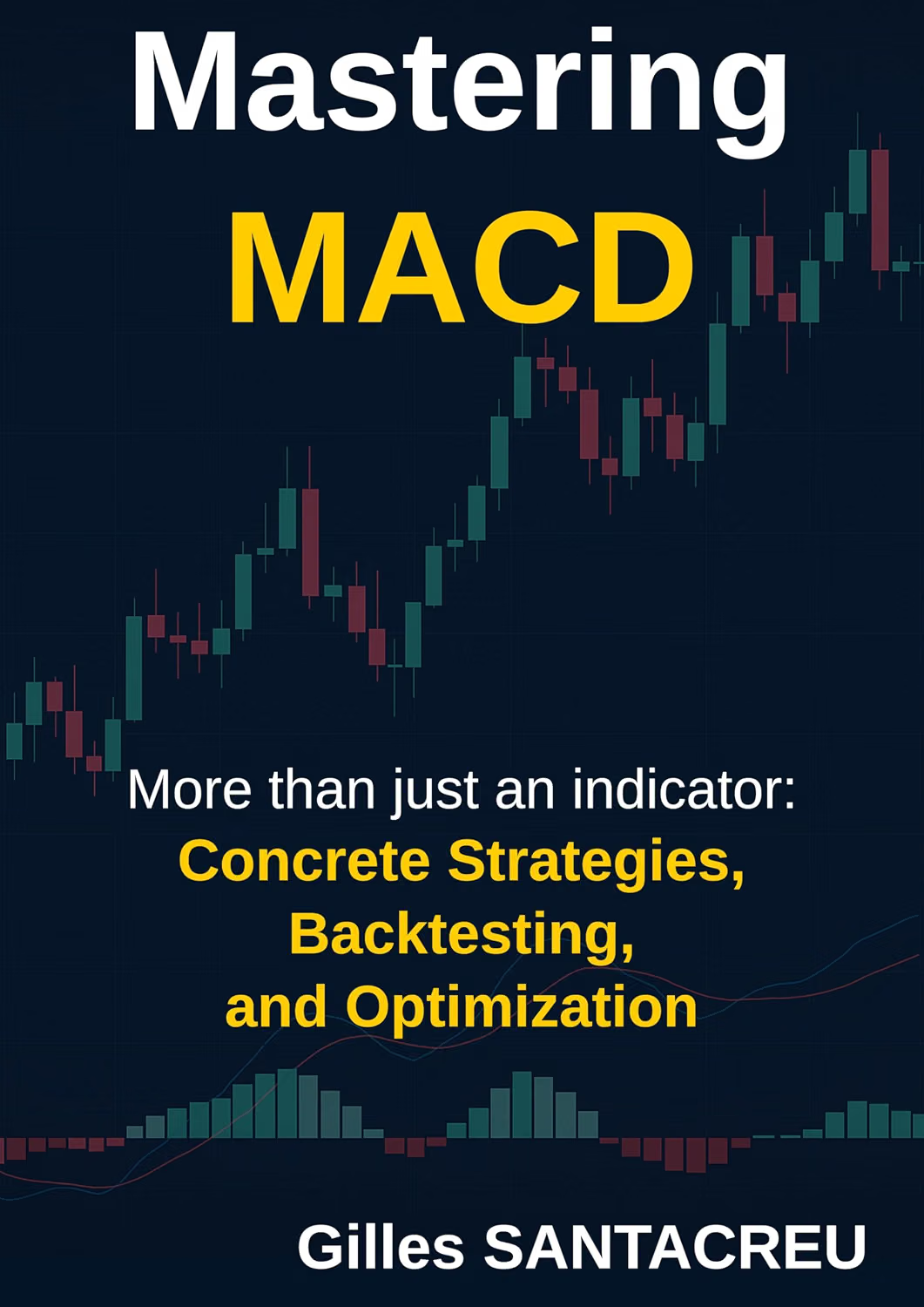


Mastering MACD: More than just an indicator. Concrete strategies, Backtesting, Optimization.
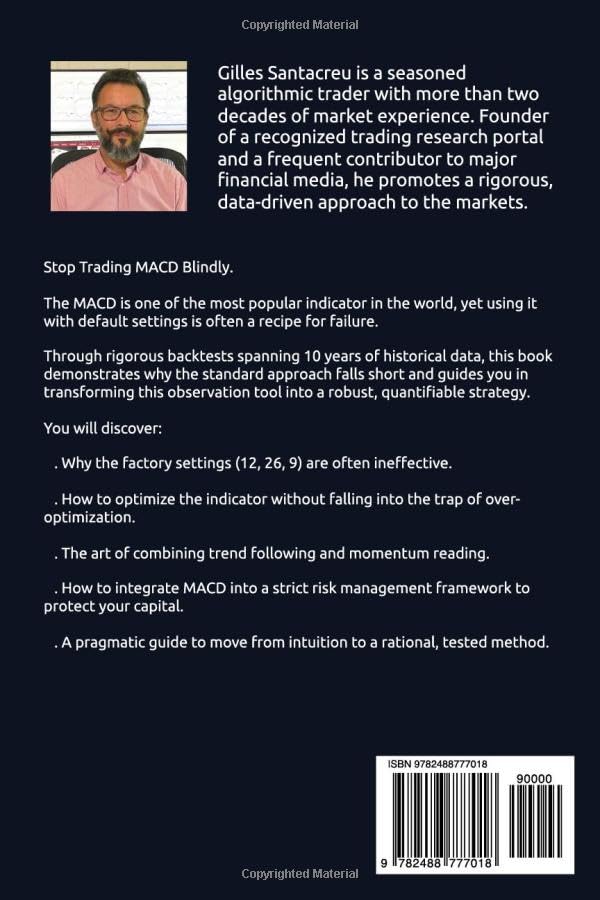
The MACD’s default settings — 12, 26, 9 — lose money on most markets. Backtested over ten years of data, this practical guide by algorithmic trader Gilles Santacreu shows how to recalibrate the indicator for your asset and timeframe, avoid over-optimisation, and turn a MACD signal into a complete, rule-based trading plan. Includes backtest reports, the MT5 chart template and the tools used in the book.
Et une variante plus courte (deux phrases) si WoodMart affiche la description courte dans les grilles produits :
The MACD’s default settings lose money on most markets. This backtested guide shows how to recalibrate the indicator for your asset and timeframe and build a complete trading plan around it — MT5 template and backtest reports included.
The MACD everyone uses, and the MACD that actually works
Open any charting platform, add the MACD, and you get 12, 26, 9. Those three numbers were chosen decades ago for daily stock charts. Most traders never touch them, then apply the indicator to a 15-minute forex chart or a stock index and wonder why the signals keep arriving late, or fire in the middle of a range. Run the numbers on ten years of price history and the answer is unambiguous: on most instruments, trading the default MACD is a way to lose money slowly.
This book starts from that measurement and works forward. It is written by a trader who has spent twenty years in the markets and who builds automated systems for a living — which means every claim in it has been through a backtest before it went on the page.
What is inside
Why the defaults fail. A short, honest diagnosis of what 12/26/9 assumes about a market, and why those assumptions rarely hold on the instruments and timeframes most people trade today.
Two indicators in one. The MACD line and the histogram do different jobs. One follows trends through crossovers; the other measures momentum and can flag a move before it shows up in price. The book treats them as two separate tools and shows how to combine them rather than reading them as one signal.
Calibrating for your market. A step-by-step procedure for adapting the MACD parameters to a given asset — forex pairs, indices, and others — and timeframe. The method is designed to find settings that are robust rather than settings that fit the past, and it explains how to recognise when you have crossed the line into over-optimisation.
From a signal to a system. An entry signal on its own is not a strategy. The book adds what is usually missing: position sizing, stop placement, exit logic and risk limits, so that a MACD signal becomes a complete, rule-based trading plan you can actually follow — or code.
The full backtest, not just the good parts. A detailed walk through a set of backtests on EUR/USD on the hourly chart, starting from a losing configuration and showing each change that turned it into a robust one. Equity curves, drawdowns and statistics are shown as they are.
What you get with the book
QR codes and links inside the book give you the material used to write it:
- the complete backtest reports discussed in the text
- the chart template for MetaTrader 5, so you can reproduce the setup in a few clicks
- access to the tools used throughout the book
Who should read it
Discretionary traders who want a reliable way to filter entries and stop second-guessing the indicator. Algorithmic traders who need a tested, well-defined logic to build an Expert Advisor around. In both cases, the aim is the same: to know what the MACD is telling you, what it is not, and how much to risk on it.
No magic formula, no promise of easy money. A method, the data behind it, and the tools to test it yourself.
| Pages | 101 |
|---|---|
| Language | English |