


Strategic Money Management: Quantitative Methods to Size Positions, Manage Risk, and Compound Wealth
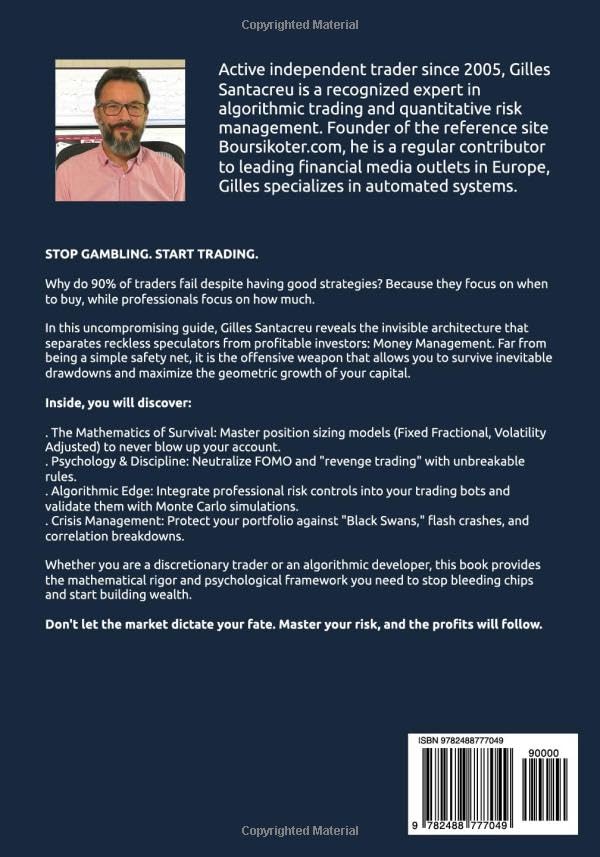
Most trading accounts are not lost to a bad strategy. They are lost to position sizes that were never calculated, drawdowns that were never planned for, and decisions made under stress. This 519-page guide by algorithmic trader Gilles Santacreu turns risk management into a method: psychology, the mathematics of ruin, position sizing models, backtesting and Monte Carlo validation — with the real-world failures (LTCM, Barings, Archegos) that show what happens when the method is missing.
The skill that decides whether you are still trading next year
Ask a losing trader what went wrong and you will usually hear about a strategy: a setup that stopped working, an indicator that gave a false signal. Look at the account statement and you will see something else — a position that was too large for the account, a losing streak that was statistically normal but emotionally unbearable, a series of “just this once” decisions that turned a manageable drawdown into a margin call.
That gap between what traders blame and what actually empties accounts is the subject of this book. It is not a collection of tips. It is a complete framework for deciding, before every trade, how much to risk and why — and for proving, with numbers, that the framework survives the worst the market can do.
What the book covers
Part 1 — Psychology and discipline. Why the first obstacle is not the market but the trader: cognitive biases, self-sabotage, and how a rules-based money management system removes emotion from the decisions that matter most.
Part 2 — Fundamentals. Risk of ruin, drawdown and recovery mathematics, capital allocation by trading style, and a chapter on why “normal” risk models fail — how Mandelbrot’s fractal view of markets explains crashes that standard models call impossible.
Part 3 — Strategies. Optimising reward-to-risk, diversification and hedging, correlation between assets, advanced sizing techniques, and worked examples of money management for swing trading, day trading and long-term investing.
Part 4 — Algorithmic trading. Dynamic position sizing, backtesting and optimising the money management layer itself, and risk control in high-frequency contexts. These are the models the author uses in his own Expert Advisors, not textbook abstractions.
Part 5 — Crises and practice. Portfolio analysis of well-known traders, case studies, the impact of AI on risk management, and how to refine your own rules over time.
Learn from the failures that made the headlines
The book examines the risk management errors behind three of the most expensive collapses in trading history: the leverage and model risk that sank LTCM, the loss spiral of rogue trader Nick Leeson at Barings, and the invisible leverage that destroyed Archegos. Each case is read through the same lens: which rule was missing, and what it would have cost to follow it.
Beyond the 1–2% rule
If your position sizing consists of “never risk more than 2% per trade”, this book will show you what that rule ignores: the correlation between open positions, the effect of losing streaks on account size, the difference between fixed fractional and volatility-based sizing, and how to test any sizing rule with a Monte Carlo simulation before trusting it with real capital.
Who this book is for
- New traders who want to build on rules rather than luck from the start.
- Experienced discretionary traders whose results are capped by drawdowns and inconsistency rather than by their strategy.
- Quantitative and algorithmic traders who need a rigorous, testable money management layer for their systems.
- Long-term investors who want a portfolio that survives crises instead of one that is rebuilt after them.
About the author
Gilles Santacreu is a self-taught algorithmic trader and technical analyst with over fifteen years in the markets, founder of boursikoter.com and a regular market commentator on French financial television. He develops MQL4/MQL5 Expert Advisors and writes about trading from the standpoint of a practitioner: everything in this book has been tested against real data before being written down.
Included with your purchase: online money management toolkit
Buyers get access to a dedicated members-only page with position sizing and risk management tools built to accompany the book. Create an account on this site and send us proof of purchase (your Amazon invoice, or a screenshot of your Amazon review). Access is opened within a short delay.
Details
- Author: Gilles Santacreu
- Format: 7″ × 10″ (17.78 × 25.4 cm)
- Pages: 519
- Print: black & white
- Editions: paperback and hardcover
- Language: English
Table of contents
Foreword · Introduction
Part 1 — Psychology and Financial Discipline
- Why psychology is the trader’s first obstacle
- Building an unbreakable discipline
- Money management as a remedy for cognitive biases
Part 2 — Money Management Fundamentals 4. Understanding money management 5. Key concepts of market risk 6. Capital allocation and trading styles 7. The illusion of normality — understanding the nature of risk 8. Advanced risk management concepts
Part 3 — Money Management Strategies 10. Optimising the reward-to-risk ratio 11. Diversification, hedging and asset correlation 12. Advanced money management techniques 13. Money management examples by strategy 14. Advanced analysis tools and methods
Part 4 — Money Management in Algorithmic Trading 16. Position sizing and dynamic adaptation 17. Backtesting and optimising money management 18. Risk management in high-frequency trading
Part 5 — Crises and Practice 20. Portfolio analysis of famous traders 21. Money management case studies 22. The future impact of AI and algorithms on money management 23. Refining your risk management over time
Conclusion and Outlook · Appendices
| Language | English |
|---|---|
| Lenght | 508 pages |
| Weight | 2.39 Pounds |
| Dimensions | 7 x 1.15 x 10 inches |